Wikipedia offers a concise definition of a Political Action Committee (PAC):

“In the United States, a political action committee (PAC) is a tax-exempt 527 organization that pools campaign contributions from members and donates those funds to campaigns for or against candidates, ballot initiatives, or legislation.”

One good definition of gray money comes from the Brennan Center for Justice:

What causes gray money? Disclosure rules that overlook the true sources of funding. Super PACs — PACs that are supposed to advertise independent of candidates and, after Citizens Unitedand related cases, can raise and spend unlimited sums — typically must disclose their donors.

But increasingly they have disclosed not individuals or businesses, whose interests are relatively apparent, but rather other PACs. That money might be traceable, through multiple layers of PAC disclosures, to an original source. But most people lack the time to dig this deeply, and, increasingly, understaffed newsrooms do, too. (Super PACs sometimes disclose nonprofits as donors. Because nonprofits generally do not have to disclose their donors, we consider PAC spending derived from such sources to be dark money, not gray.)

While PACs are a legitimate way for groups to support causes and candidates, they also provide an avenue for immense influence by wealthy donors and organizations. By raising and channeling vast sums of money, PACs can create significant disparities in access to elected representatives and influence over policy decisions.

According to data obtained from NJ Elec, over 50 Million Dollars were donated to County Party Committees and PACs across New Jersey’s 21 Counties across a five year period (2019 through 2023).

totalcontfinal121

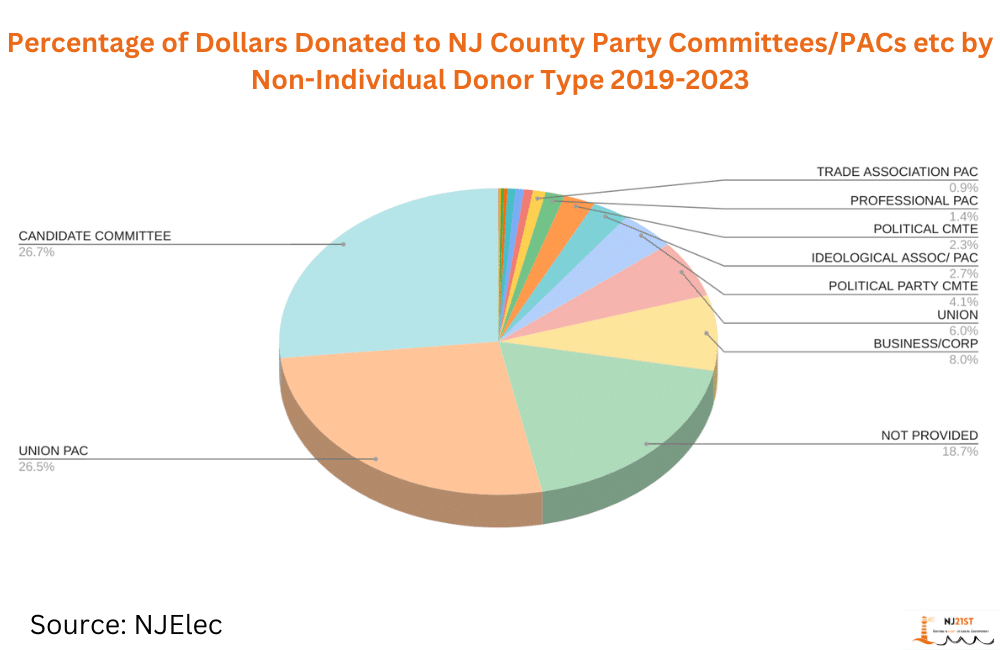
While 63% of these contributions came from Individual Donors, 79% of the dollars going into County Party Committees and PACs came from other non-individual sources (PAC’s, Committees, Election Funds).

donation type 11 28 2024

Candidate Committees and Union Political Action Committees accounted for over 50% of contributions made in the data set.

breakdownfinal121

The NJ Elec database reveals challenges in data transparency, with 20% of contributions lacking a defined entity type, several missing street addresses, and some contributor names omitted.

Additionally, the same entity may refer to themselves differently making it difficult to understand the total amounts coming from each entity. For example, an election fund for Craig Coughlin appeared under eight different name variations with contributions that ultimately totaled nearly a half million dollars.

Screenshot 2024 12 01 2.25.08 PM

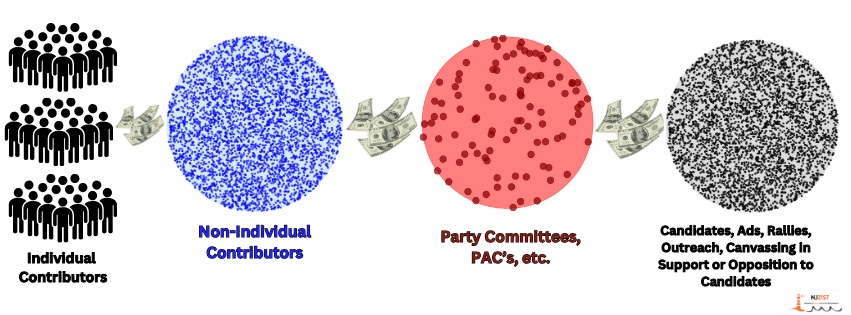
When you also consider that, across all NJ Counties, there were nearly four thousand non-individual accounts feeding money into one hundred other non-individual accounts during this time period, tracking the source of dollars seems near impossible.

moneyflow final121

We’ve created flashcards for each New Jersey county, highlighting information about non-individual contributions.

Support NJ21st and Stay Involved

Your support helps keep local and state government transparent and accountable.


💡

Make a Financial Contribution

Your contribution fuels our reporting, public records work and statewide transparency projects.

Support NJ21st
✍️

Contribute Your Writing and Get Involved

Have insights or documents about local or statewide issues? Become a community contributor and help strengthen public understanding.

Get Involved
📬

Subscribe for Daily Updates

Get daily updates on local and state government decisions, documents, hearings and accountability work delivered straight to your inbox.

NJ21st is an independent nonprofit civic journalism project focused on transparency, public records and accountability in both local and state government.