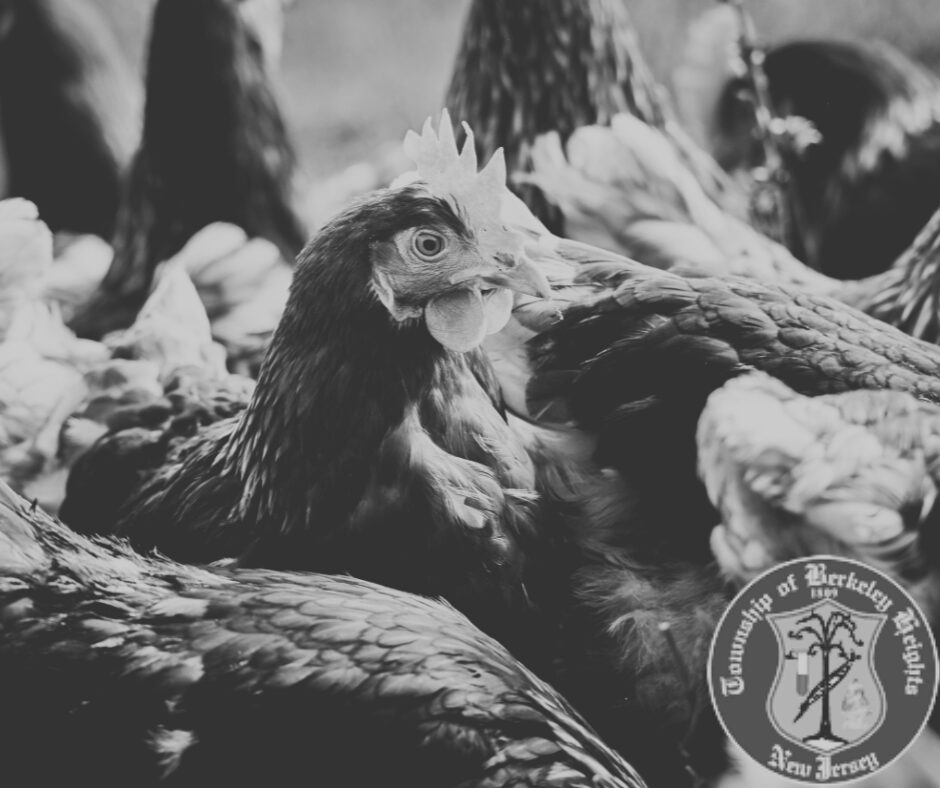
Berkeley Heights Town Council has drafted a new ordinance for residents who wish to keep chickens. After hearing from several residents at the September 16, 2025 Town Council meeting, where the ‘livestock’ ordinance was on the agenda, township attorney Scott Salmon shared new regulations which will be officially introduced at an upcoming meeting. This new draft, a copy of an ordinance from Teaneck, NJ, was discussed during the October 7, 2025 council meeting. Homeowner and keeper of a flock of much-loved hens, Chris Johnson, has a lot at stake, as do a small handful of other Berkeley Heights residents with chickens.
Johnson and his family all spoke at the meeting on September 16th about the many benefits attained from raising chickens. Friends and neighbors also showed up to lend their support. While council members were mildly supportive, in general, there were many concerns raised. A lengthy discussion ensued again during the October meeting, with many of the same concerns expressed by the members of the Council. The township solicited Johnson’s assessment of the draft, and he responded to some of the suggested requirements with his own experience and in-depth knowledge.
One potential issue with the proposed ordinance was flock size: the number of hens was understood to be limited to six. Johnson’s reply to the town’s new recommendations explains that hens are social and need to be around others. Deanna Talerico, a homesteader and educator with over 15 years experience, says, “Chickens are flock animals and thrive with several buddies around. They tend to eat, forage, and lounge around in groups together, too.” Sy Montgomery, the author of What the Chicken Knows: A New Appreciation of the World’s Most Familiar Bird, also notes that chickens can recognize up to 100 other chickens. During the 12/02 meeting, the Township clarified a firm limit has not yet been established.
Further, Montgomery writes, chickens can recognize themselves in the mirror (showing a startling level of self-awareness), are known to give gifts, and can even play and invent games with members of their flock. In addition to social needs, flock size is obviously linked to the number of eggs produced. Limiting flocks to six would not provide a sufficient number of eggs year-round for a family of four. Johnson, in his response, informs Town Council members that as hens age, they produce fewer eggs, and that as daylight hours wane, egg production is also reduced as chickens moult and regrow their feathers. The Johnsons do not cull their hens as their egg-laying wanes, and limiting the number to six would mean having to choose between egg production and the humane practice of letting the hens live out their full lives, which can be between 10 and 15 years.
Johnson told NJ21st, “The big point I want people to understand is that the number of birds only matter in the extreme – flocks that are too small suffer and flocks that are way too big for the space given suffer. There’s zero difference in the already negligible public impact between a well-kept flock of six or a well-kept flock of 20” adding, “Backyard flocks are of no nuisance to anyone unless they are neglected, same as any other animal.” The Johnson family is seeking the ability to keep a flock of 12 hens. Although many towns cap the number at six, it’s worth noting that Jersey City allows up to 50 hens, provided that setbacks are followed, and Glen Ridge and Aberdeen allow 8. Town Council President John Foster correctly noted that the number of chickens allowed, as the ordinance is written now, will already be restricted by regulations regarding the minimum amount of space per hen. Council Member Susan Poage brought up a very relevant point when she asked how many families currently have more than six chickens. The fact is that this is not currently a problem, and is not likely to become a problem. Lastly, Council Member Bill Machado told the others that he had visited the Johnson’s coop and noted that it was “state of the art” and “very well maintained”.
Johnson, who works in public service, and his wife Karen, a registered nurse and eighth-generation Vermonter whose family are farmers, have offered to help the town, with Karen telling Town Council members that she is willing to volunteer to help inspect coops and educate town residents. The response document submitted to the Town Council contained additional information and comments which could be of help to members of Town Council in making revisions that are tailored to Berkeley Heights, rather than Teaneck. NJ21st will keep residents posted when this ordinance is posted on the Town Council’s agenda.
Editor’s Note: Clip of Shauna speaking to issue during the 12/02/2025 Town Council Meeting.
|
Related Articles

Proposed 2026-27 School Aid: How Berkeley Heights, New Providence and Other Nearby Districts Fared in New Jersey’s Budget

Major Land Use Changes Advance in Berkeley Heights as OPRA Dispute and Transparency Questions Surface