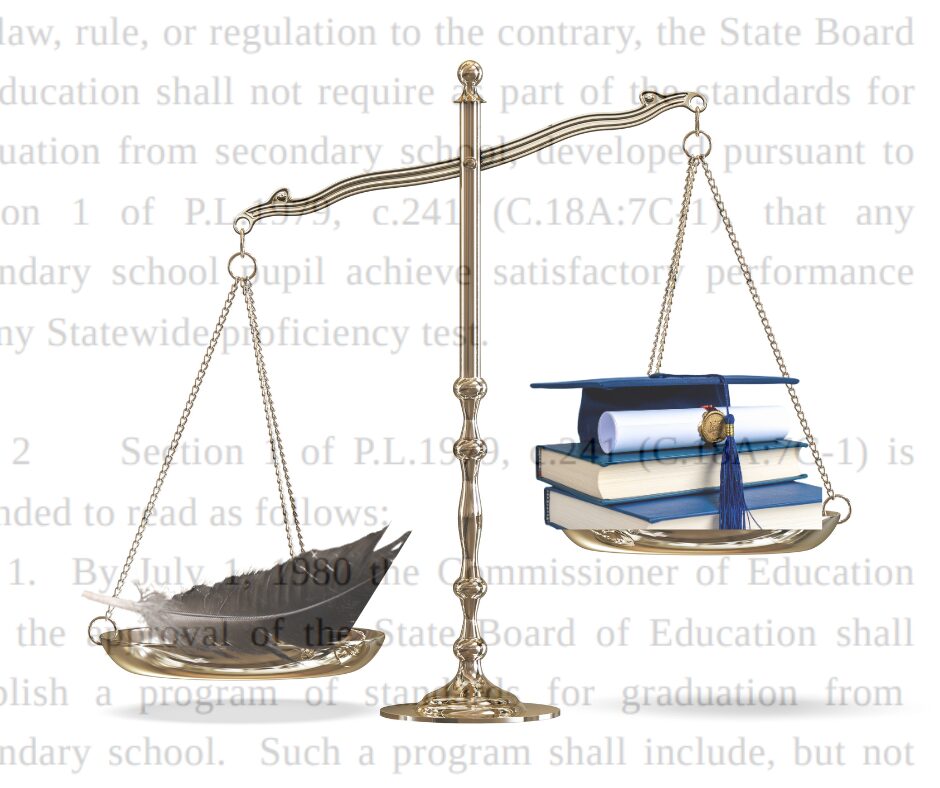
Adding to a pile of lame-duck high impact bills, A4121- which would eliminate the NJGPA (high school graduation proficiency test) passed Assembly yesterday.
Under the bill the State Board of Education would no longer be allowed to require students to pass a statewide proficiency test as a condition of graduation and all statutory references to the exam would be removed. Local Districts would be responsible for establishing graduation standards along with a whole host of other changes including erasing the ability for adults and out-of-school youth to obtain a NJ degree through the exam. From an accountability standpoint, school report cards would drop the measure from it’s pages.
NJ21st sent an email on December 5, 2025 to various legislators and state leaders raising concerns about eliminating the test without establishing a robust alternative. I argued that the exam not only served as a measure of individual student proficiency but, perhaps more importantly, a benchmark for districts across the state that allowed for meaningful end-point comparisons and oversight. I warned that without a statewide test stakeholders would lose a critical tool in detecting achievement gaps and a way to identify whether local grading practices mask deeper problems.
The email included four recommendations…
-Maintain statewide proficiency exams as an accountability measure even if the requirement is repealed – results must remain public and comparable across districts so families, communities and policymakers can understand where improvement is needed.
-Build in a mechanisms where test results act as a catalyst for meaningful consequences – required improvement plans, stronger DOE oversight, targeted support for struggling schools and improvement timelines.
-Guaranteed access to free remediation courses at community colleges so students can succeed in attaining a four year degree or in learning a trade
-A mechanism for defining chronic failure in districts and allow parents to seek alternative placements including inter-district choice, charter schools or private schools.
Legislators and staff responded and acknowledged the seriousness of the issues raised; Assemblyman Brian Bergen’s office confirmed that the message would be brought directly to his attention.
NJ Education Report published an op-ed titled “Dishonesty Hiding in Plain Sight: Testimony on NJ’s High School Diploma Test.” which pulls testimony from educators who describe inconsistent grading and diploma granting practices in some districts. It points out that without a statewide exam it would be difficult for the public or the state to know whether diploma standards are being upheld uniformly. It also argues that the exam is a check against grade inflation and thin air credit granting.
Supporters of the bill argue that the statewide exam is redundant given other assessments already administered annually and that local control better allows schools to reflect coursework, grades and student portfolios rather than one high-stakes test
Critics argue that removing the exam without replacing it with an adequate statewide accountability system reduces transparency, masks inequities and weakens comparability of diplomas across the state. They express concern that this change will widen disparities and make it harder to track overall student performance. NJ21st’s email and the NJ Education Report op-ed both reflect these concerns.
This vote comes at the same time the state is rolling out the new adaptive NJSLA with little clarity on whether results will be comparable across districts or aligned to any consistent performance standard. If the state replaces the NJGPA while introducing an adaptive test that does not produce uniform benchmarks, New Jersey may enter a period where understanding how schools are performing becomes near-impossible. That concern occurs in a context of statewide declines and stagnation across key subjects.
Then there is the incredibly questionable spending occurring at the local level. Wealthier communities such as Berkeley Heights continue to invest in niche “nice to have” boutique athletic positions as an example, while students in many economically disadvantaged districts struggle to access basic supports such as tutoring. Across the state most, if not all Districts are throwing massive amounts of money into police economies that demonstrate no objective value to schools or academic success – in fact, quite the opposite. Without a strong statewide measure these disparities risk becoming even harder to identify and address.
Sophie Nieto-Munoz of the New Jersey Monitor reports “A companion bill was introduced in the Senate in January 2024, but it has yet to be scheduled for a hearing before the chamber’s education committee. The Legislature has until Jan. 13 to pass any bills under consideration before a new session begins.”
|
Related Articles
NJ WARN On Track for 4-Year High: BH & Madison on the 2026 Lay-Off Radar
Your Property Taxes at Work: From Roof Repairs to $25,000 Flagpoles for Our Schools