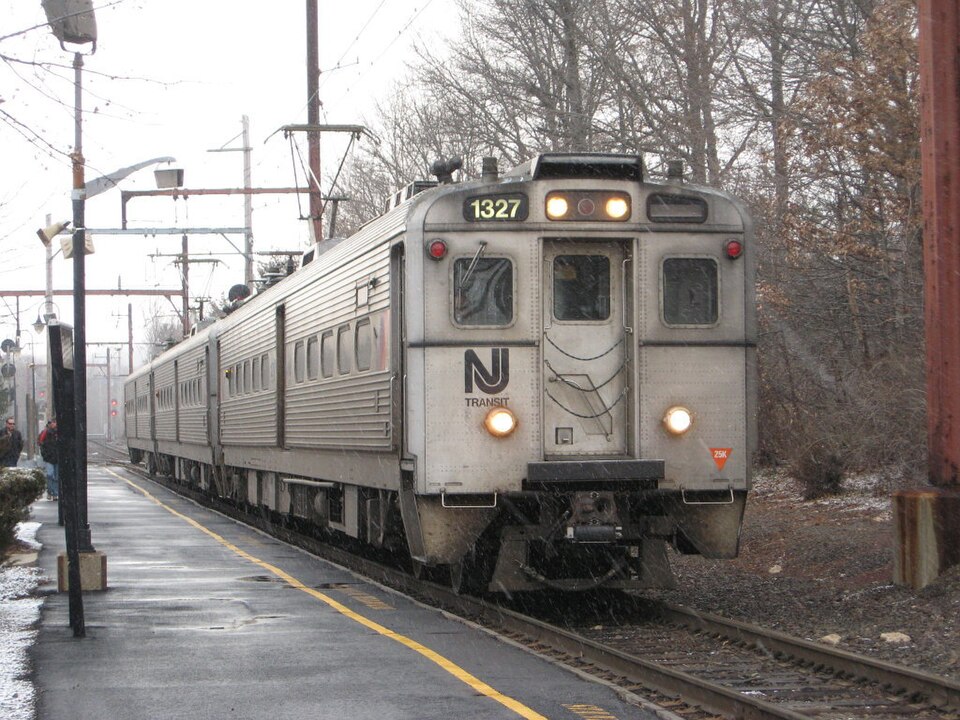
Image Credit: Adam E. Moreira
We received an email from a reader asking that we put a lens on ADA gaps at NJ Transit stations. From his email…
“The Americans with Disabilities Act (ADA), enacted in 1990, specified that public accommodation services, such as NJ Transit, need to achieve compliance standards with reasonable efforts through timely planning and funding. The North Jersey Transportation Planning Authority, New Jersey Transportation Trust, and Federal Railroad Administration all discuss disabled access as a strategic goal and provide funding opportunities to achieve it. There is also an All Stations Accessibility Program intended to achieve ADA standards.
………..
ADA accessibility affects individuals, workers, students, and parents of disabled children’s independence. County Commissioners and municipal governing bodies need to better achieve these rail transit accessibility goals for District residents.”
Context
Under ADA Title II (49 CFR Part 37), older systems were allowed to designate certain locations as “Key Stations” for priority upgrades which then allowed a bunch of secondary stations to stay “as-is” for decades. The law gave agencies a good amount of leeway in the timeline for retrofitting non-key locations.
35 years after the ADA became law, accessibility remains uneven across New Jersey’s rail system but this lack of accessibility was never meant to be optional or indefinite.
Inconsistent compliance with the ADA can be seen along the Morris and Essex Line and the Gladstone Branch.
Summit Station, for example, is listed by NJ Transit as ADA accessible, with high-level platforms and elevator access.
However, Berkeley Heights, New Providence, and Murray Hill are not listed by NJ Transit as ADA-accessible stations.
These stations rely on low-level platforms, which present physical barriers. Passengers need to climb steep metal steps to get on or exit trains, which creates an absolute barrier for folks who use wheelchairs and a serious challenge for seniors. Older stations may also have wider gaps between the edge of the platform and the train door, which makes getting on a train harder for folks with limited mobility.
At these non-accessible stations, boarding is also constrained. NJ Transit’s accessibility materials describe the use of bridge plates as a boarding aid specifically for stations with compatible high-level platforms. Low-level stations like Murray Hill and New Providence do not show a boarding method that allows a wheelchair user to access the train on NJ Transit materials. While bridge plates are referenced, stations like Murray Hill and New Providence may not have the necessary platform height for those to work. This essentially prevents residents with limited mobility from using these specific stations.
Impact
Upgrading older “legacy” stations is a complicated and expensive process which requires heavy engineering and funding. However, as one reader wrote, the lack of ADA compliance directly impacts the ability of residents to reach jobs, healthcare, and education.
Public health research, including studies supported by the Robert Wood Johnson Foundation, consistently links a lack of reliable transportation to delayed or forgone medical care. For small train towns like Berkeley Heights and New Providence, a lack of accessibility can impact the local economy and limits the ability of aging residents to remain in their communities due to changes in their mobility.
Opportunity
The Federal Railroad Administration’s All Stations Accessibility Program (ASAP), established by the 2021 Bipartisan Infrastructure Law, set up a dedicated stream for these exact types of upgrades. NJ Transit recently utilized this Federal program to secure $83.3 million for the Brick Church Station modernization, which gives evidence to the belief that significant federal resources are available if local leaders and NJ Transit prioritize applications for the Gladstone Branch.
Outlook
As of this article – Berkeley Heights, Murray Hill and New Providence do not appear to have any immediate or near-term plans documented for the structural changes needed to hit ADA compliance with higher utilized hubs like Brick Church and Perth Amboy targeted for major federal grants. There is, however, some peripheral progress – Berkeley Heights was recently awarded a contract to install ADA-compliant curb ramps leading to the station, and New Providence has slated general track and “mobility maintenance” for the coming year. However, these are more about maintenance than transformation.
I reached out to the County asking if there were any plans on the radar to apply for grants or something already underway not reflected in the documents I looked at.
Last Note
In researching the subject (because I’ve never really thought about this before we got the email) I came across a great article for those looking to find ADA compliant stations on The Montclair Girl.
Also see: NJ Transit 10 Year Strategic Plan
|
Related Articles

Statement on the Foster Campaign Petition Challenge

Berkeley Heights 2026 Budget Proposed at $35M: Here is Where the Money is Going