Regardless of your immigration status, you have important protections under the US Constitution and NJ law in your encounters with not only ICE but Law Enforcement in general.
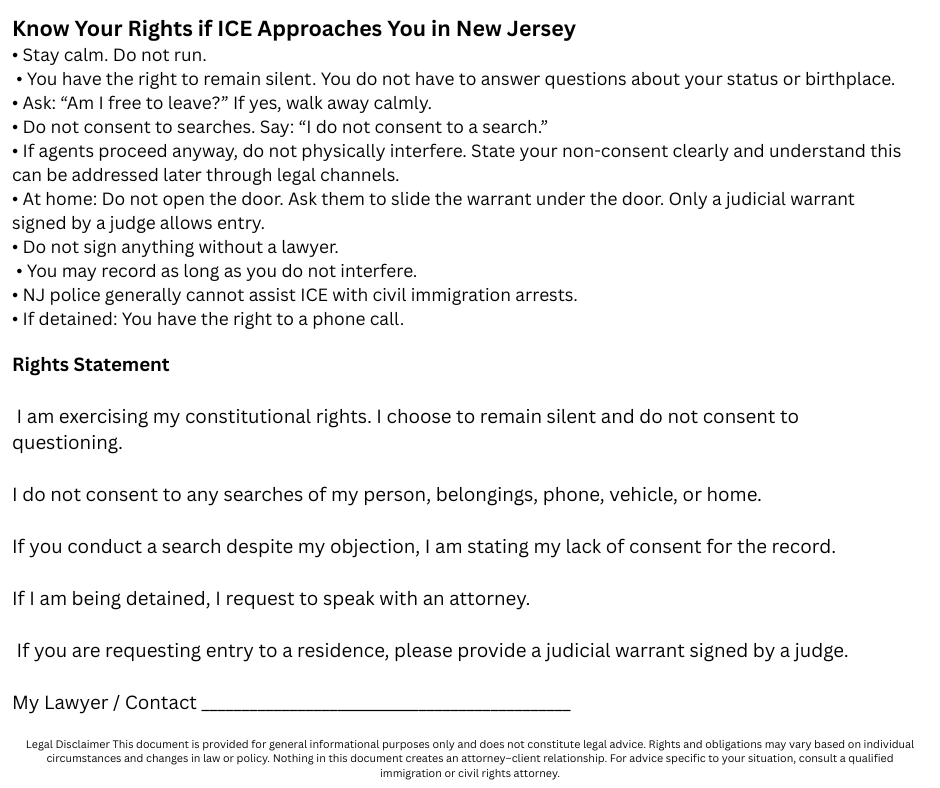
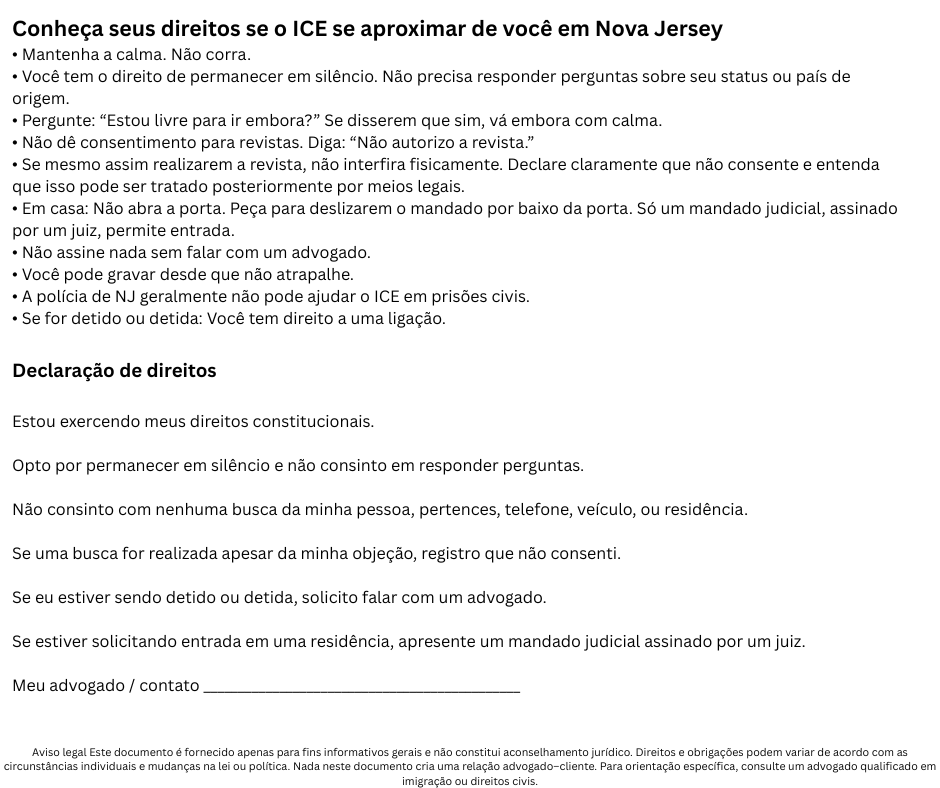
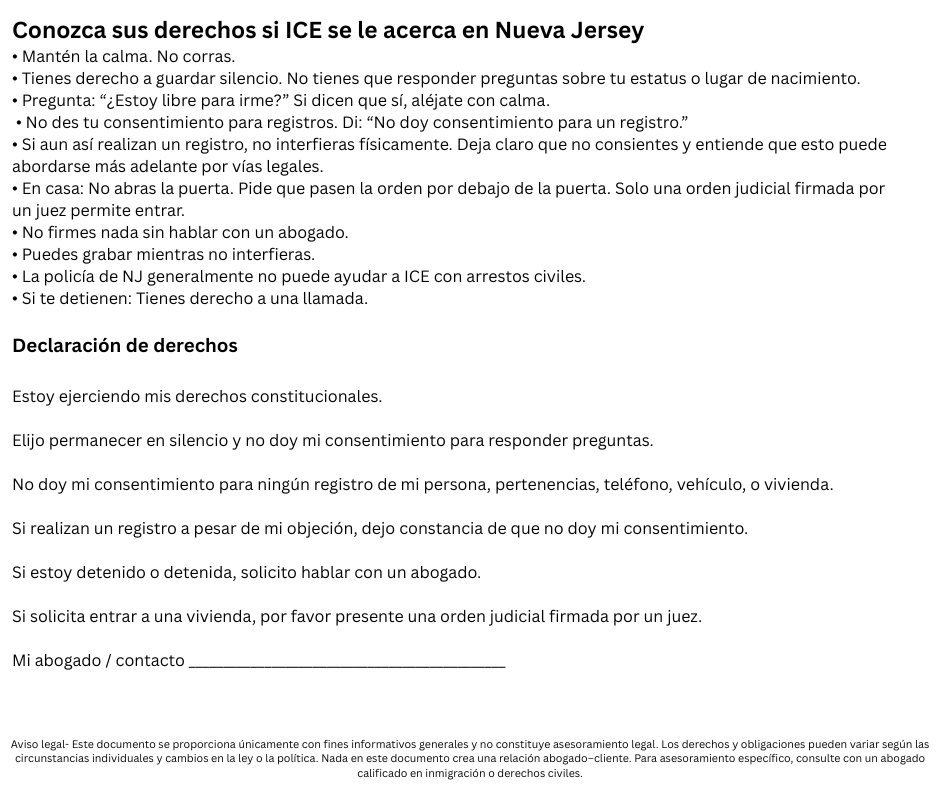
We created “Know Your Rights” reference cards in English, Spanish (Español), and Portuguese (Português) – meant to be a tool outlining critical information…
Right to Silence: You are NOT required to answer questions about your birthplace or citizenship.
Consent: You have the right to refuse a search of your person, home, or vehicle unless agents (or police) present a judicial warrant signed by a judge.
New Jersey Protections: Under state directives, local law enforcement is generally restricted from getting involved in civil immigration arrests.
Right To A Phone Call: Please have a phone number to an attorney or advocate readily accessible – this should be your first call in the event you’re detained.
Right to Record: You have the right to record any interaction with law enforcement as long as you don’t interfere with what they’re doing. You can ask for name and badge number for your record.
Please download, print, or save these images to your phone. Each card includes a “Rights Statement” that can be shown directly to an officer to help you advocate for yourself clearly and calmly.
Know Your Rights Cards: Download by Language
Tap “Download image” to save the card to your phone or print it. If your browser opens the image instead of downloading, use the download icon or “Save image as.”
Update 01/13/2026 @934pm…
Given the large number of comments suggesting that undocumented residents do not have the same right as US Citizens when interacting with law enforcement under the constitution, I thought it was important to point out that for nearly 150 years the Supreme Court has ruled that Constitutional Right applied to anyone on US Soil.
Yick Wo v Hopkins-Oyes (1886)– “The Fourteenth Amendment to the Constitution is not confined to the protection of citizens…[it applies] to all persons within the territorial jurisdiction, without regard to any differences of race, of color, or of nationality.” link
Wong Wing v United States (1896)– “It must be concluded that all persons within the territory of the United States are entitled to the protection guaranteed by those amendments, and that even aliens shall not be held to answer for a capital or other infamous crime, unless on a presentment or indictment of a grand jury, nor be deprived of life, liberty, or property without due process of law.” link
Plyer v Doe (1982)- “Whatever his status under the immigration laws, an alien is surely a ‘person’ in any ordinary sense of that term… [and] is entitled to that constitutional protection.” link
Zadvydas v. Davis (2001)-“The Due Process Clause applies to all ‘persons’ within the United States, including aliens, whether their presence here is lawful, unlawful, temporary, or permanent.” link
|
Related Articles

The ACFR Dashboard (Part 5): The True Cost of School Security

Beyond the Cameras: AI, Police Access, and the BHPSNJ Referendum