The twelfth article in an ongoing series intended to help NJ residents, especially students, understand their local and state government
Like Boards of Education re-orgs which we covered in the last entry of this series, NJ Municipalities hold a reorganization meeting in January, the first official meeting of a municipality’s governing body in the new year. These meetings are required by law and act as an official reset of local government for the new calendar year. Another similarity to BOE re-orgs is that municipal reorganizations are usually quiet and procedural, which makes them easy to overlook.
That would be a mistake.
Reorganization meetings shape how local government runs for the rest of the year along with the “when” and “how” major decisions are made.
And like BOE re-org meeting, the purpose of municipal re-org involve…
-Getting elected officials (Council Members, Mayors etc) sworn in and leadership established
– Adopting meeting rules
-Reauthorizing administrative and financial processes
-Designating official newspapers
-Making Appointments to positions required by law
-Passing a temporary budget that allows town to conduct business until the full annual budget is approved
-Approving things like who can sign bank documents, petty cash funds, bid limits, purchasing authority,
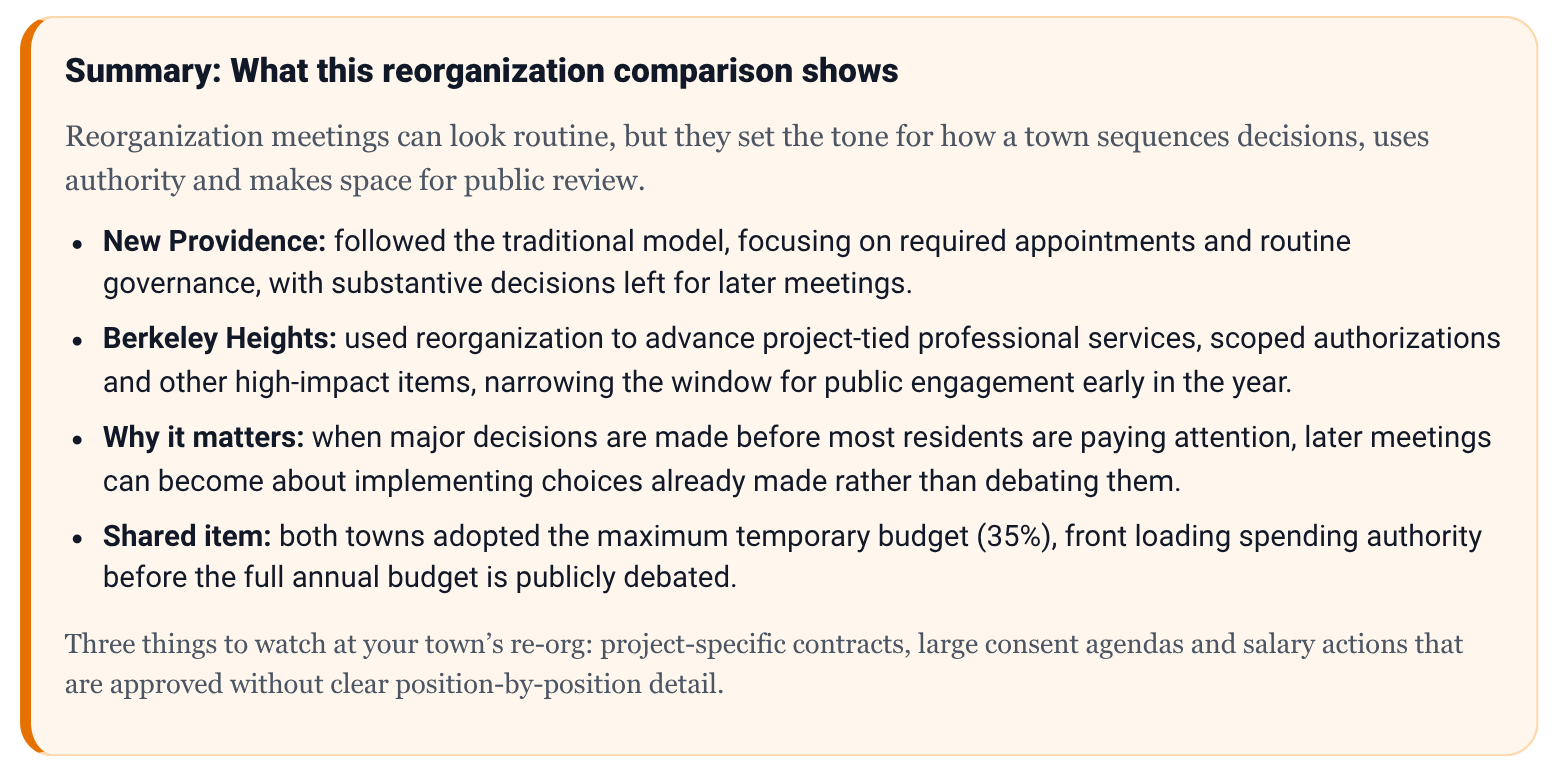
In many municipalities reorganization meetings focus primarily on what’s required – the necessary appointments and routine governance. Typically, decisions on active policy, capital projects or discretionary spending are avoided – these more substantive decisions are usually pushed to meetings later in January or February when attendance is higher, council leadership has settled in and residents have had a little space to review materials.
While this separation isn’t legally required, it’s a common practice that promotes transparency and allows for more deliberation and public feedback on important decisions.
Tale of Two Reorganization Meetings
New Providence
New Providence’s 2026 reorg meeting follows a traditional approach – a long agenda made up (mostly) of standard appointments and resolutions. There aren’t any project-specific professional service contracts, capital projects or policy ordinances.
The reorganization meeting is strictly about resetting the framework.
Berkeley Heights
The Berkeley Heights 2026 reorganization meeting agenda reveals a far different approach and includes multiple professional service contracts tied to specific projects, each with defined scopes and not-to-exceed dollar amounts – all of it alongside the standard items one would expect at a re-org meeting.
Again, none of this is illegal, but the fact that it’s all rolled into the first meeting of the year is noteworthy and a departure from how most municipalities approach their first meeting of the year.
When important decisions connected to price tags occur before residents have much opportunity to pay attention and oversight is crammed into a single meeting, it forces the later discussions to focus on implementing a decision that has already been made rather than deliberating the decision itself.
OPRA Defense Fund
The handling of OPRA-related legal services in Berkeley Heights deserves special attention.
As we covered earlier in this series, OPRA exists to ensure that the public has access to government records and many towns handle OPRA issues through general legal services. We also pointed out how 2024 legislative amendments to OPRA in NJ gave municipalities more tools to deny requests and reduced the penalties for towns that that broke the law while reducing incentives for attorneys to take municipalities to court on contingency.
Separating this one item into its own legal bucket with a dedicated budget signals that records access has become a significant issue – not just a routine administrative task.
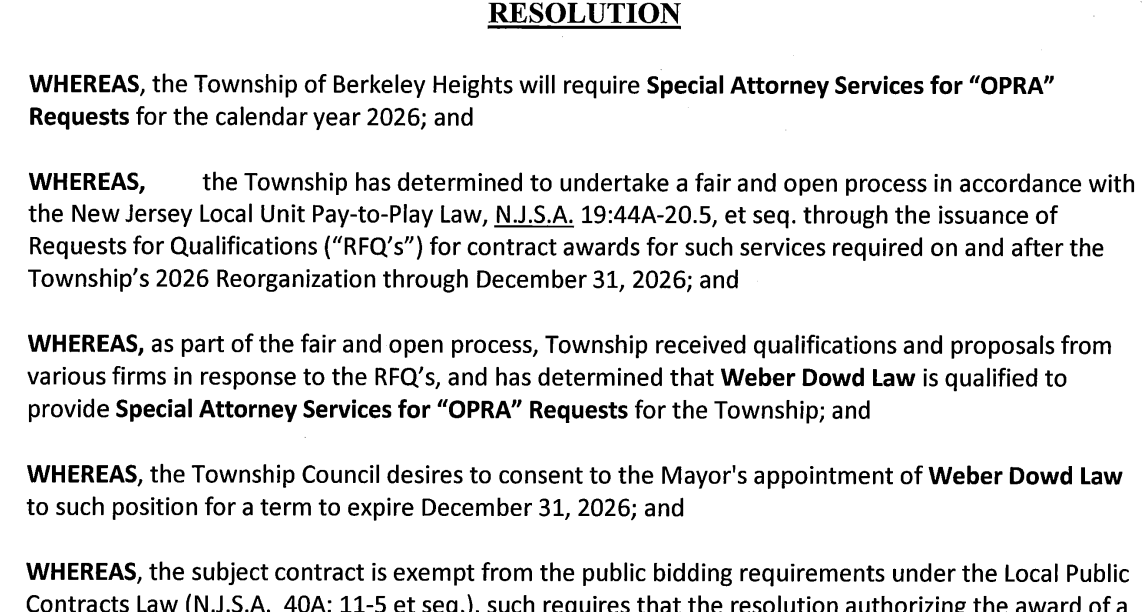
Why does the simple act of accessing public records need a dedicated, line-item legal team?
When a municipality creates a separate “bucket” of taxpayer money just for records disputes, it suggests one of three things:
They are anticipating a high volume of legal challenges OR They are adopting a more defensive/litigious posture toward public information OR Both.
This may signal that the town isn’t just performing a routine task – they are budgeting for a battle.
Locking Projects In
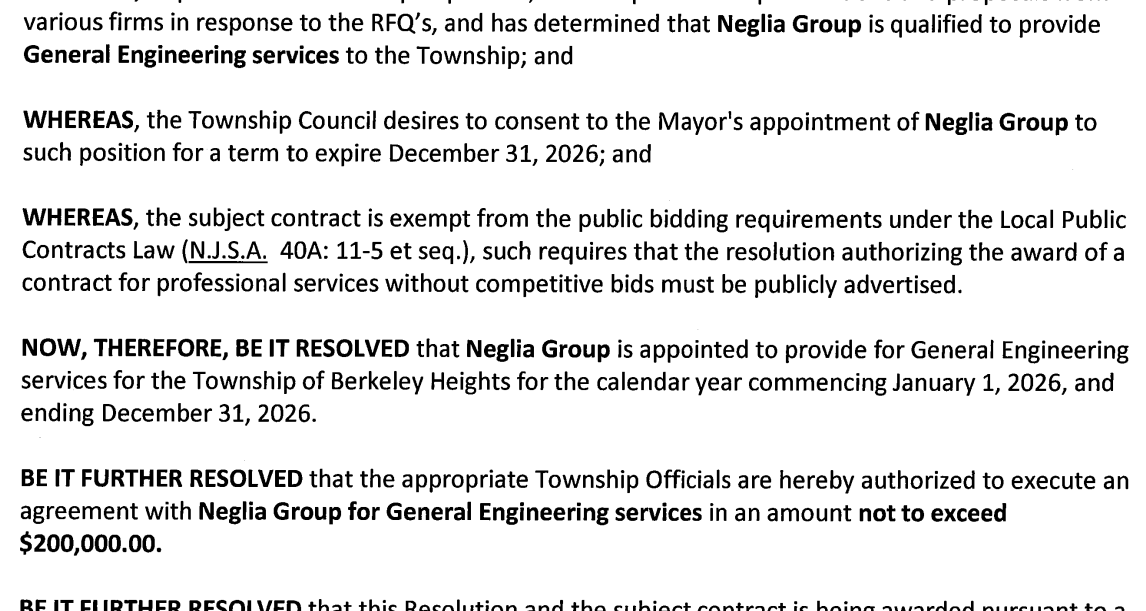
When architectural and engineering services are authorized at reorganization, project momentum is established immediately- scope and cost tends to be locked in. Once that work begins, it becomes a lot harder for a new council or the public to meaningfully reconsider or influence direction. These are all decisions that have a significant potential long term impact on a town’s budget and planning.
Global Salary Adjustments
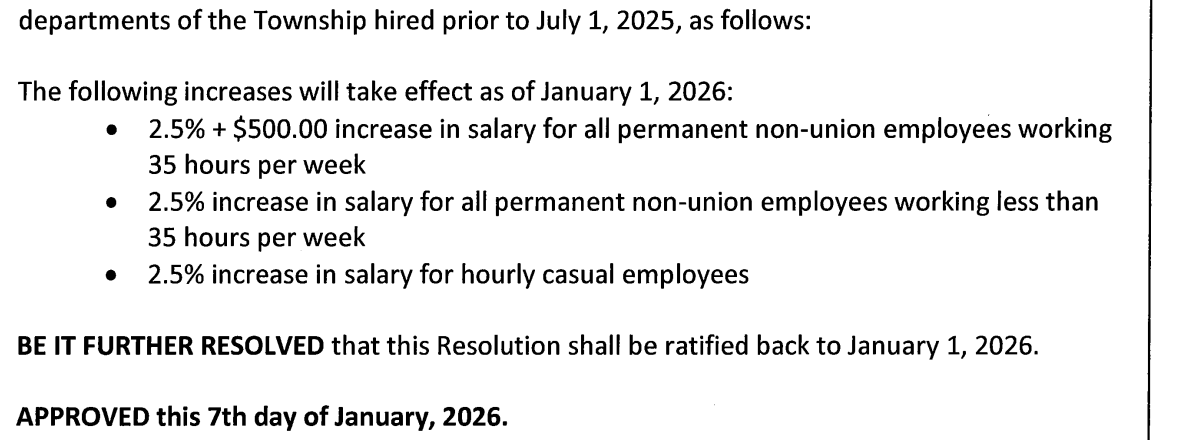
Salary actions approved at reorganization can raise the same concerns. Approving global salary adjustments without listing individual positions or amounts essentially limits public visibility at a meeting that few residents attend. While individual salaries may later appear in payroll records, the decision point itself occurs with minimal public context.
Missing Text
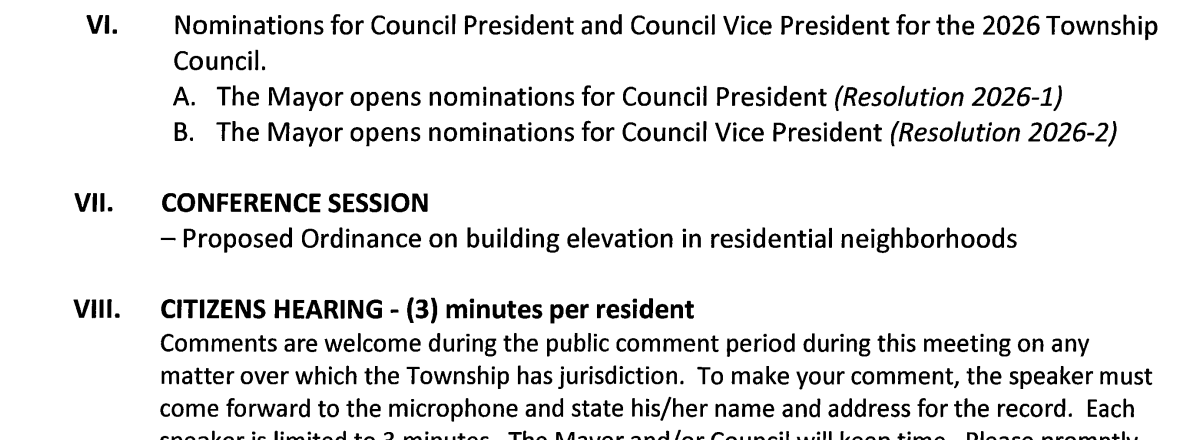
Then there’s the agenda item referencing a “Proposed ordinance on building elevation in residential neighborhoods” which brings up another transparency concern. When policy is discussed without providing the ordinance language in advance, residents can’t evaluate impact or provide informed input. How can residents intelligently discuss an ordinance on demand during a public meeting without having the opportunity to review the proposal in advance. The practice of putting out amended Agendas or having materials available right when the meeting starts can add more salt to the wound as it comes across as a cosmetic gesture.
The Commonality
There is one item that both Berkeley Heights and New Providence share a similar approach on – the temporary budget- both authorizing the maximum temporary budget percentage (35%).
A temporary budget would normally account for 26.25% of the prior year to cover the first quarter of spending.
Pushing the amount an additional 10% front-loads millions in spending before the full annual budget is publicly debated. The concern is not so much about overspending but how much financial authority is exercised before residents even get an opportunity to discuss and debate priorities.
Looking at the whole agenda- putting all these deviations together- the approach taken by Berkeley Heights changes the primary function of the reorganization meeting from a procedural reset to a launch point for substantive decision making in a way that narrows the window for public engagement right from the start.
So while New Providence follows the traditional model of just “resetting the clock” for the new year, Berkeley Heights is using its reorganization meeting to conduct serious business, commit millions and advance specific capital and policy goals.
Three Things to Look For
The take-away is that reorganization meetings matter precisely because, while they appear routine, they reveal how local governments sequence decisions and exercise authority. A reorganization meeting can also be an important indicator of how strongly a municipal government values transparency, public input and feedback.
Three questions to have on your mind as you approach your town or city’s re-org meeting…
Are there project-specific contracts (Engineering/Architectural) or just “General” appointments?
Is there a “Consent Agenda” that hides dozen of resolutions under one vote?
Are there “Salary Resolutions” that don’t list specific names or titles?
Explore the Entire ‘Understanding Your NJ Government’ Series
|
Related Articles

Lower Columbia Project Raises New Questions About Funding, Permits and Public Notice

2026 7-Municipality Budget Analysis