
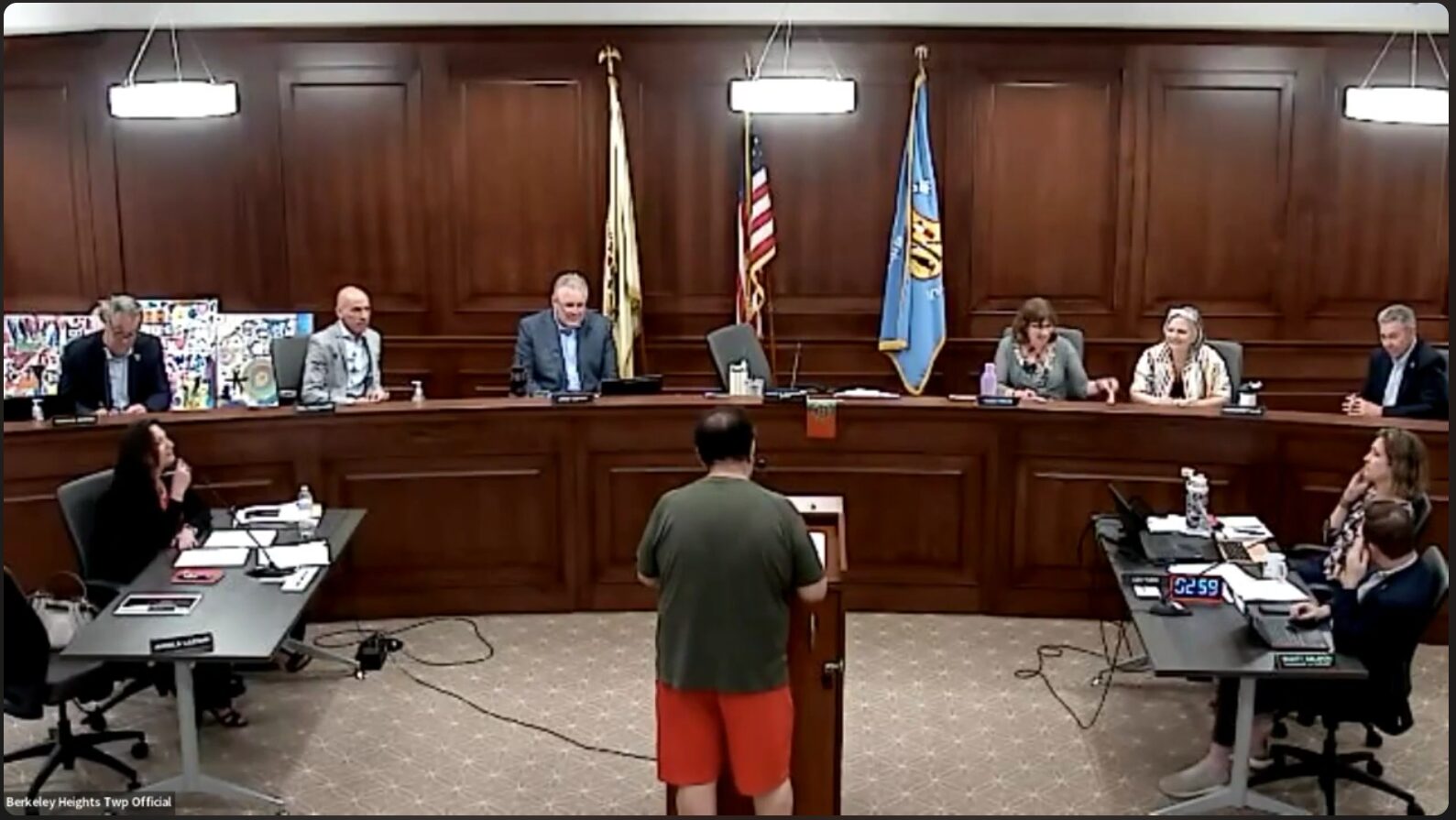
The June 30th meeting of the Berkeley Heights Town Council was one for the record books, both in attendance and length. The conference room was filled, with residents lining the sides and back of the room, and more standing and sitting outside in the hallway. The meeting lasted nearly five and a half hours, with more residents than usual hanging in until the very end. The meeting was fiery, and at times unruly, serving to highlight residents’ concerns over both the process by which we learned of the proposal to dissolve the Recreation Commission and the dissolution itself.
In an effort to keep this article from being as long as the meeting itself, we’ll focus on the main points, including other ordinances and presentations. We’ll also share limited resident comments and township responses, as it’s important to highlight some prevalent attitudes of those sitting at the dais.
The meeting opened with a presentation by JCP&L. The representatives spoke about some of the infrastructure and what needs to be repaired. They did not answer where Berkeley Heights falls in terms of priority for those repairs and upgrades. Two residents spoke on this issue, sharing numbers of outages, which have increased since we last heard from the utility company, and insight into how even one-minute outages can ruin electronic equipment at Nokia. In a humorous moment, one resident turned out the lights in the meeting room, garnering laughs from all while highlighting the seriousness of power loss.
The ordinance on the Recreation Commission was supposed to happen next, but the screen that would show the PowerPoint presentation was not working. That ended up not being a terrible occurrence, since many of those in the room did not have a view of the screen anyway. The Township Clerk went to make paper copies, and Council member Margaret Shore-Illis spoke about changes to the town’s tree ordinance in the interim. One resident noted that 250 trees were removed from the former Westminster Presbyterian property and asked where the town would plant that many trees to replace those lost, also bringing up the flooding and water runoff that will be a concern with no trees to absorb rainwater.
As the meeting finally arrived at the proposed ordinance, up for first read, to dissolve the Recreation Commission and replace it with a Recreation Department that would fall under the control of the Mayor and Town Council, things started to heat up, literally and figuratively, with the temperature inside the room reaching 80 degrees at one point.
The township attorney, Scott Salmon, was the one who presented the ordinance and gave the township’s reasoning behind the proposed move. Included in these reasons were “everyone else is doing it”, increased transparency, and claims that Recreation Commission members didn’t have the expertise to stay abreast of State regulations and laws. As his somewhat lengthy presentation went on, the feel in the room was one of agitation, with many residents whispering angrily amongst themselves.
Town Council members were given the opportunity to ask questions first, prior to the opening of public comment, and their questions and comments only served to ramp up the dissatisfaction gaining traction in the room. Council member Susan Poage started, and was not close enough to her microphone to be heard by those in the back half of the room. Upon being asked to speak up, she chose to scold residents, telling them maybe they could hear if they were quiet, leading to gasps and “oooohhhs” from the crowd. As Council members asked their “questions”, it became very apparent that those questions were actually – in nearly all cases – leading questions thinly veiled as statements that would allow the attorney to reiterate points designed to try and convince residents to approve what appeared to be pre-determined results in the minds of the Council. In speaking to some residents after the meeting, and listening to comments being made around me, this was something felt by many – that Council was there to change our minds. The single Town Council member that seemed to be able to read the room was Andrew Moran, who mentioned the many emails and conversations he’d had with residents and stated that it’s important for the Council to listen to their concerns. In general, the main “feel” of the Council question period was that they failed to understand that residents did not want Recreation under the purview of the township, and that many were not trusting the “nothing will change” verbiage delivered by the township. It’s also worth noting that our two mayoral candidates both blamed social media for spreading misinformation and generating these concerns.
Upon the opening of public comment, a steady stream of residents stood to speak; many more than can be listed here. Their commentary over the next hours showed a deep appreciation for Carolyn George and the volunteers from Recreation.
One common question was about the funds in the Recreation trust. While it was clear to all that those funds can only be used for recreation purposes, Mr. Salmon struggled to explain WHO could direct those funds and determine which projects they would be used for if the Recreation Commission became the Recreation Department, and who had final approval of that spending. With the new ordinance, the chain of command puts the Recreation Director (more on this title later) under the township, so it wasn’t clear if the decisions or recommendations made by the new Recreation Department could be overridden. A small handful of residents pointed out that the proposed Department encompasses “parks” and “fields”, leading to speculation about funds being used for Peppertown Park or the Lower Columbia Field. Despite Township Administrator Liza Viana’s statements that those projects would be paid for by grants and donations, heavy skepticism remained, which is complicated by connections to Mayor Devanney’s appointment of Deb Varnerin, who resigned from the Recreation Commission, to a paid position of Project Manager for the Lower Columbia Field.
A second common topic was about the audit and evaluation of the Recreation Commission. The results of this evaluation are one of the main drivers of the proposal. According to the township, no one associated with the Recreation Commission has the necessary knowledge to avoid violating state statutes and laws, demonstrated by the findings of the audit. Current Recreation Chairperson, Sean McDonnell, noted that the audit he was given was still in draft form. When pressed, Mr. Salmon declined to explain to residents what the actual findings of ‘wrongdoing’ consisted of. Ed Kingsley told the Council and town’s residents that in the evaluation they “really did not find anything of substance at all”, continuing to say that he met with the CFO and she said there was “nothing outstanding from a financial perspective” that would necessitate giving control of Recreation to the town. Other residents spoke about possible training that could help alleviate any concerns about following the law and pointing out that the township has run afoul of statutes and regulations as well, resulting in heavy fines, so insisting that anyone from township is more qualified than anyone from Recreation doesn’t hold.
As the public comment continued, I could hear a group of seniors and residents behind me expressing sentiments such as ‘nothing changes until everything changes’ and ‘nothing changes – for now – until the new mayor or council members decide it changes’. At the same time, the person currently at the podium spoke of how, when New Providence moved to having a Recreation Department, they then hired six people, leading to increased demand on taxpayers. Another commented that Warren’s Rec Department has fewer employees, but that their only offering for youth is tennis.
There were many speakers whose comments were notable. For me, the stand-out was Jeanne Kingsley, and I encourage everyone to watch her (if not the rest of the 5.5 hour meeting) to get a concise view of what issues residents were expressing. In addition, while it can’t be seen on camera, resident Ed Gallitelli asked those in the crowd who were there to oppose dissolving the Commission to stand up. I saw one person not standing. Not a single resident stood up to speak in favor of the ordinance.
There are a small number of residents who would have you believe this opposition to the ordinance was spearheaded by “clowns” and “instigators” whose only raison d’etre is to sow division, but last night showed that publishing and speaking about the business of our town, our Board of Education, our elections, and other issues of interest is an important way for residents to stay informed.
Many, many of the speakers commented on the lack of communication, the lack of Town Council participation in Recreation Commission meetings, which are open to the public, and the feeling that there was more going on than merely changing the form of the Commission. One member of the Commission expressed reservations about making what has been an apolitical group a political entity. Susan Poage replied by claiming Town Council isn’t political, which generated an outburst in the room and led to her being told, “Read the room.”
The final “theme” of the comments from last night centered around the fact that everyone felt blindsided by this ordinance and suspicious of the timing. Several noted that the beginning of all this centered around the abrupt resignation of the Recreation Chair last year. One member of the Recreation Commission said, “I want to believe that there’s nothing nefarious going on here. And that’s a tough word” then continuing, “I don’t like the word, but I can’t put my finger on what’s going on.”
As the end of this part of the meeting came to a close, it was Andrew Moran, not Susan Poage or John Foster, who showed – as he did at the beginning – that he could read the room, and he beat both mayoral candidates to the punch by making the motion to remove the ordinance from the agenda.
Final portions of the meeting included a discussion about studies and stop signs on Washington, Lincoln and Garfield, payments for… honestly I don’t remember at this point, and comments about the proposed ordinance which would ban data centers. This last issue should be of interest to everyone in town, and it’s unfortunate that it came at the end of a VERY long night with the Recreation Commission ordinance taking center stage. Five residents spoke about needing more research, involving the town’s planner, and asking that the ordinance not move forward until that could be done. One resident spoke for the ban. The ordinance did move forward and was approved for first reading, despite the majority of speakers asking for more review before approving. We will follow with a dedicated article shortly, as this topic is deserving of its own space.
|
Related Articles

Amendments to Recreation and Terrace II Ordinance – But Is It Enough?
CMS Delays and a Missing Bills List: Residents Press the Township on Accountability