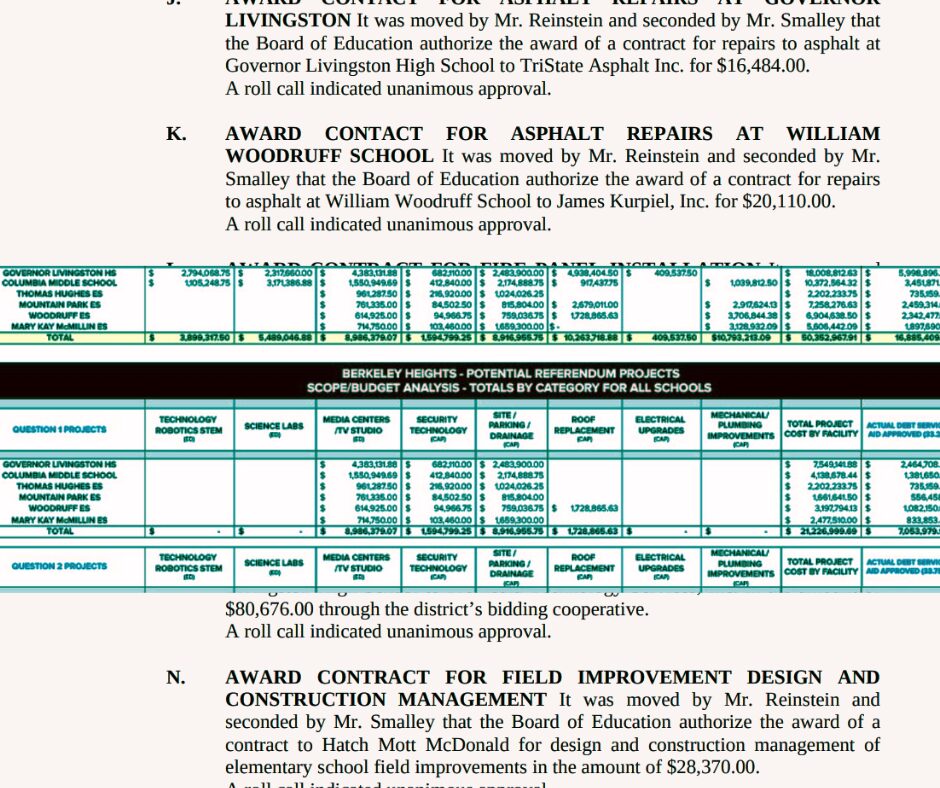
An agenda from a 2009-2010 Berkeley Heights Board of Education meeting showed the following items:
- AWARD CONTRACT FOR ELECTRICAL UPGRADES: It was moved by Mr. Reinstein and seconded by Mr. Smalley that the Board of Education authorize the award of a contract to Sal Electric for electrical upgrades at Governor Livingston High School for $16,643.15, through the District’s Bidding Cooperative.
- AWARD CONTACT [sic] FOR ASPHALT REPAIRS AT GOVERNOR LIVINGSTON: It was moved by Mr. Reinstein and seconded by Mr. Smalley that the Board of Education authorize the award of a contract for repairs to asphalt at Governor Livingston High School to TriState Asphalt Inc. for $16,484.00.
- AWARD CONTACT [sic] FOR ASPHALT REPAIRS AT WILLIAM WOODRUFF SCHOOL: It was moved by Mr. Reinstein and seconded by Mr. Smalley that the Board of Education authorize the award of a contract for repairs to asphalt at William Woodruff School to James Kurpiel, Inc. for $20,110.00.
- AWARD CONTRACT FOR FIRE PANEL INSTALLATION: It was moved by Mr. Reinstein and seconded by Mr. Smalley that the Board of Education authorize the award of a contract for installing an additional fire panel installation at Governor Livingston High School to A.C. Daughtry in the amount of $17,000.00. Explanatory Note: Fire and smoke alarms are being installed in classrooms as ceilings are upgraded. These additional devices require an additional panel to be added.
- AWARD CONTRACT FOR SECURITY CAMERA INSTALLATION: It was moved by Mr. Reinstein and seconded by Mr. Smalley that the Board of Education authorize the award of a contract for installation of security cameras at Governor Livingston High School to Promedia Technology Services, Inc. in the amount of $80,676.00 through the district’s bidding cooperative.
- AWARD CONTRACT FOR FIELD IMPROVEMENT DESIGN AND CONSTRUCTION MANAGEMENT: It was moved by Mr. Reinstein and seconded by Mr. Smalley that the Board of Education authorize the award of a contract to Hatch Mott McDonald for design and construction management of elementary school field improvements in the amount of $28,370.00.
These items are all things that are currently being proposed via a referendum. This agenda shows that projects of this nature can, and HAVE BEEN, included in the district’s budget. While keeping in mind that inflation needs to be taken into account, these numbers and projects demonstrated two points that need to be considered as Berkeley Heights moves toward a vote on the referendum.
One point is that, despite claims, the schools are NOT in the original condition and state that they were when the schools were built. Repairs, upgrades, and additions have clearly been happening on an ongoing basis. Residents should be aware that some of the statements being presented as facts by advocates of the referendum are exaggerated or flat-out false. The district CAN manage infrastructure on a yearly basis if they take a hard look at where we are currently spending on items that do not enhance student learning or other positive student outcomes.
The other point is that these are smaller amounts (even adjusting for inflation). There will be times that referendums may be needed to address larger items. The district can improve the chances that these referendums will pass in two ways, neither of which rely on histrionics or threats.
The first is to show the public that needs are being addressed yearly, rather than being kicked down the road. In addition, they can demonstrate that they understand the need to limit spending on categories that do not have a direct benefit to students, such as security, attorneys, outside consultants, fighting OPRA requests, and being forthcoming in ways that decrease the need for residents to submit OPRA requests.
The second is that when they do present referendum projects, they take into consideration needs versus wants. The current referendum would not be receiving much of the pushback that it is if residents saw the most critical items being given priority. If there are additional projects that are desired – above and beyond inarguably crucial projects – many residents would consider an appeal to funding those secondary measures. They may, or may not pass, but few would take issue with simply being asked what their willingness is for extra spending.
It’s okay to be vigilant and apply scrutiny when being asked to spend multiple millions of dollars. Questions and criticisms don’t equate to being selfish or disregarding the education of the town’s students.
This is part of a democratic process.

Our goal in covering the Berkeley Heights Public School referendum, as with any major local government decision, is to provide a platform for residents to make informed decisions, share their perspective, and be armed with the right questions to ask.
We hope residents avoid either cheerleading or trashing the referendum — the best approach is to ask hard questions and encourage the BOE and Administration to make changes that better serve the needs of our students while also respecting the economic realities families face in our community.
Our Referendum Hub provides a thorough fact-based analysis of what works and what needs to change.
|
Related Articles

Beyond the Cameras: AI, Police Access, and the BHPSNJ Referendum
Three Paths: Dipti Khanna on the $50M Berkeley Heights Referendum