
Viswa Reddy is a Resident of Millburn
In two weeks, Millburn will vote on whether to abandon the Township Committee form of government it has used since 1857 and adopt the Council-Manager plan under the Faulkner Act. The Charter Study Commission’s members were elected last November, held eighteen public meetings, and produced a thorough report. I do not doubt their sincerity, and I am not here to question anyone’s motives. I am here to argue that the report asks the wrong question, that the reform it proposes trades away something we should be reluctant to lose, and that the data underneath this whole episode is sending my own party a message it does not appear to be reading.
I write as a longtime registered Democrat who holds no position in the party and speaks only for myself, having spent the last six weeks talking to friends on both sides of this referendum question and reading the report itself.
The report studied the government’s problems, not the voters’
Start with how the Commission learned what it learned. Its evidence base was, overwhelmingly, the people who run the government: current and former Township Committee members, business administrators, department heads, and elected officials from other towns. The problems it identified are, accordingly, the problems those insiders feel most acutely — the exhaustion of annual campaigns, the steep learning curve of a three-year term, the lame-duck stretches, the friction of the annual mayoral selection, the quorum math of a five-member body under the Open Public Meetings Act. These are real frustrations. But they are the frustrations of officeholders, and it should surprise no one that the people who hold the seats would prefer longer terms and fewer elections. You could predict most of the Commission’s findings from the chairs its witnesses sat in.
One can argue that the voters did speak: 65.3% of them voted in November to create the Commission in the first place. That is true, and it matters — but a vote to study the form of government is a mandate to look, not a diagnosis of what is broken or a verdict on the cure. It tells us residents were open to the question. It tells us nothing about which problems they actually experience or which solution they would choose. The Commission also took public comment at its meetings, but open comment from whoever chooses to show up is not the same as structured, representative research into what the electorate wants from its local government. No survey was done. No representative instrument was used. The inquiry began with solutions that appeal to insiders and then validated them with insiders, without ever establishing that voters experience Millburn’s government as failing in the ways these reforms address. In my work I’ve learned that you don’t design a solution and then go looking for the problem it solves; you start with the people you serve. Similarly, a reform process worth trusting starts with the governed (the customer) and works inward. This one ran the other way.
A real tradeoff, resolved entirely in one direction
I am genuinely of two minds about the proposal itself, and I want to be honest about both.
There is much in the Council-Manager form to like. The initiative and referendum powers it brings — the ability of residents to propose or challenge legislation directly — are a real expansion of citizen voice, and I consider it the best feature of this form. While it is not a panacea (the outcomes of the referenda are still subject to judicial review to ensure they conform to the state law), it can put not just local, but also county and state elected representatives on notice. It provides a more direct message on the local voices to elected representatives, especially on any emotive issues.
The continuity argument has force, too. The Commission’s strongest, best-supported finding is that annual elections impose genuine costs: perpetual campaigning crowds out governance, and the constant turnover the town has seen makes it hard for anyone to develop the institutional knowledge the job requires. On that narrow point, the insiders are probably right.
But continuity and accountability sit on opposite ends of the same lever, and the Commission pulled it all the way to one side. Four-year terms mean voters wait longer to remove an official who disappoints them. (While the citizens have the right to recall, the time taken for the recall effort dissuades such an effort.) Combined with nonpartisan elections — which weaken the one durable, repeat actor in local politics, the party, that can recruit, vet, and be held responsible across cycles — the proposal reduces the frequency and the structural channels of accountability at the same time. That is a coherent thing to worry about. The corporate-governance literature, for what it is worth, finds exactly this tension: longer, more secure tenure buys expertise at the cost of monitoring, and where the balance should be struck is genuinely contested. The Commission resolved that contested tradeoff completely in favor of continuity — because continuity is what its witnesses cared about — and never seriously weighed the accountability side from the voter’s vantage. My ambivalence is not split-the-difference fence-sitting. It is that a real tradeoff deserved a real reckoning, but got a one-sided one.
Nonpartisan elections do not remove party; they hide it.
The Commission’s central promise is that stripping party labels from the ballot will drain the partisanship out of local government — that there is, as the “Yes” campaign noted, no Republican or Democratic way to fill a pothole. Yet the campaign over the referendum itself told a different story. Drive through Millburn in October and the “Yes” signs sat on the same lawns as the Republican signs, the “No” signs on the same lawns as the Democratic ones. The question of whether to remove partisanship from local elections organized, almost without exception, along existing partisan lines.
That is worth pausing on. If a reform billed as transcending partisan divide cannot escape it even in the fight over its own adoption, it is hard to credit the claim that it will depoliticize everything that comes after. Partisanship does not disappear when you take it off the ballot. It moves to the lawn, the get-together, the group text, and the volunteer list — places where it is no easier to hold accountable and considerably harder to see. The partisanship the Commission wants to legislate away is real. That is precisely why pretending to abolish it by hiding the labels is the wrong remedy: it does not end the contest, it just turns off the lights.
The signal in the returns
Here is what finally moved me from skepticism to something closer to alarm — not about the charter, but about my own party.
I pulled the precinct-level returns for Millburn’s three most recent high-turnout elections: the 2022 midterm, the 2024 presidential race, and the 2025 governor’s race. In each, I compared how the Democratic Township Committee candidate ran against how the Democrat at the top of the ticket ran, precinct by precinct. The pattern is stark and consistent. In precinct after precinct, the local Democrat ran far behind the top of the ticket — on the order of twenty-seven points behind in 2024 and 2025, and roughly thirty-seven points behind in 2022.
(Each dot is one of Millburn’s 16 precincts. Vertical axis: the Democratic margin in that year’s top-of-the-ballot race — congressional in 2022, presidential in 2024 and gubernatorial in 2025; Horizontal axis: the Democratic margin in the Township Committee race in the same precinct.)
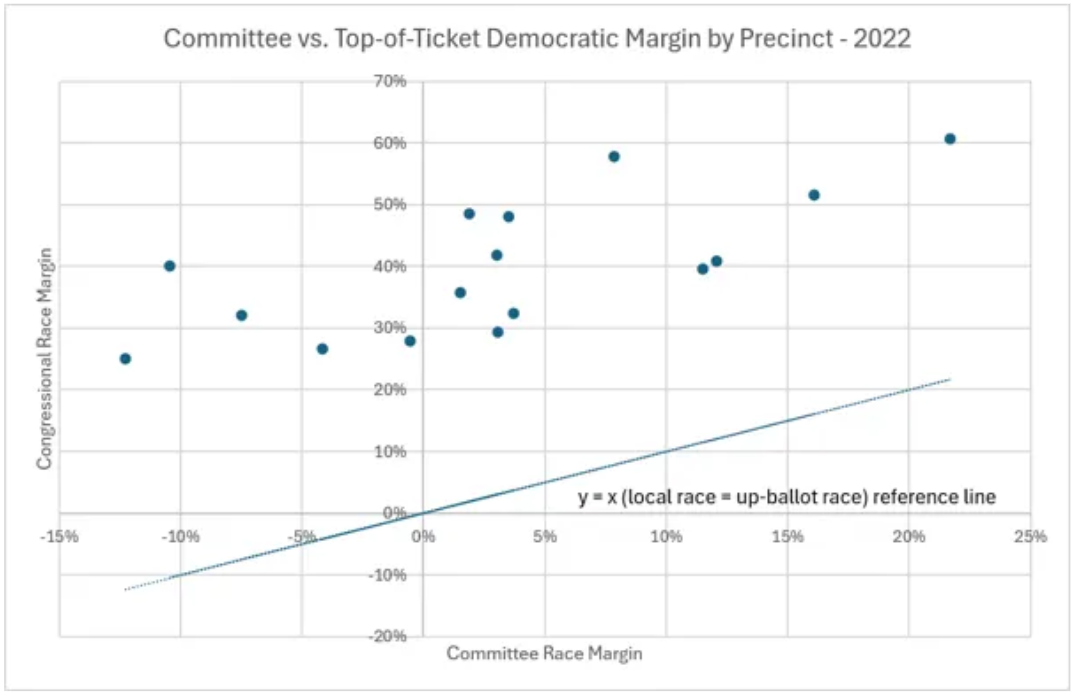
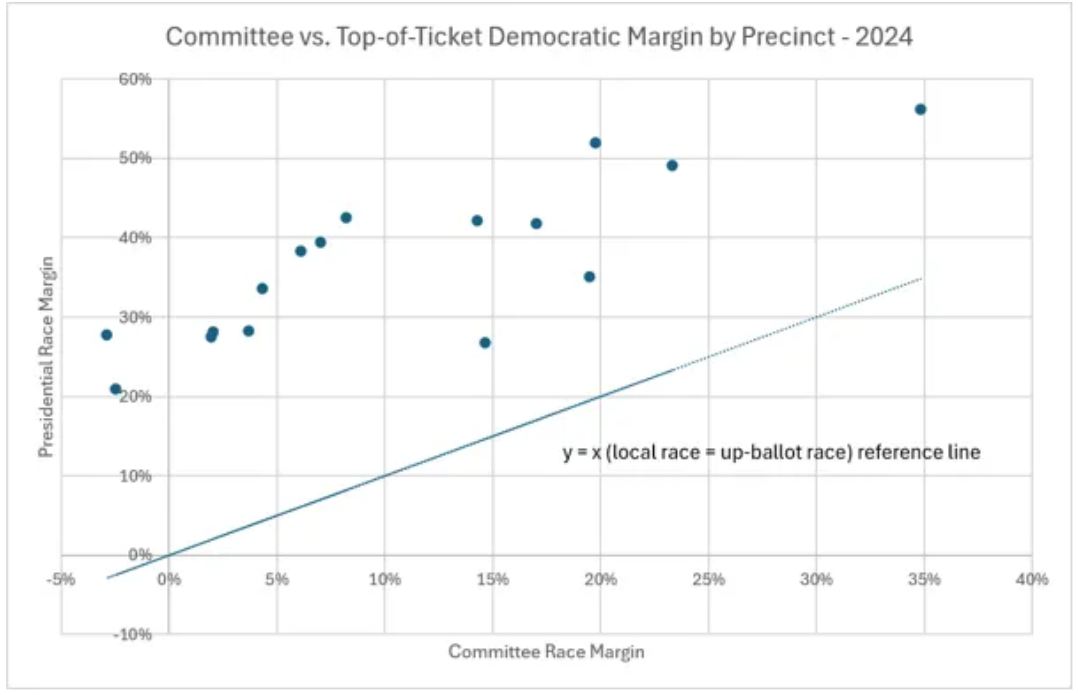
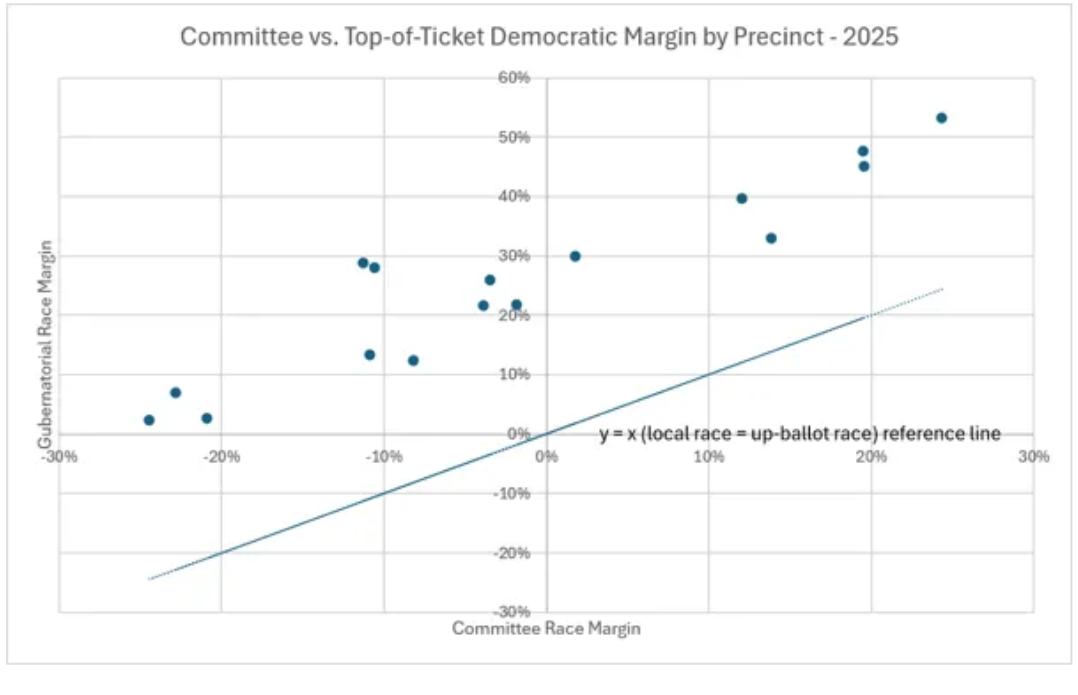
This is not the story of one or two unusually strong Republican incumbents. Township Committee seats turn over steadily here; most candidates do not run again. Yet the penalty persists across cycles and across different people on the ballot. Whatever voters are responding to attaches to the local Democratic line itself, not to particular candidates.
I cannot prove from returns alone why voters split this way. Habit, candidate quality, and genuine dissatisfaction with how local Democrats have governed are all consistent with the numbers, and I will not pretend the data settles the motive. But the conclusion my party should draw does not depend on the motive. A thirty-point local underperformance — repeated across every recent high-turnout cycle, in a town with a decisive Democratic registration advantage, and independent of who happens to be on the ballot — is a signal. A party paying attention would treat it as a five-alarm fire about its local brand.
An exhortation to the party’s leadership
Instead, my party has behaved as though its national margins entitle it to local office. It has ceded the entire conversation about the form of our government to a commission proposal it neither shaped nor seriously contested. Its primary response to the state’s affordable-housing mandate has been a shrug — what can we do against Trenton? — rather than any vision of its own for how Millburn should grow. As has been seen at the national level, you cannot win by being the party of “No”, or of no vision at all. Elections are battles over alternative futures. If you do not have one, you cede the space to the other party. No wonder that the very voters who hand the party its statewide and federal victories by comfortable margins are not willing to favor the local Democratic offer.
So this is my appeal to the leadership of the Millburn Democratic organization — a leadership I am not part of, writing about a party I have belonged to for a long time. Do the introspection these returns demand. Find out, honestly, why a town that votes blue at the top of the ticket will not vote blue for its own committee. Ask whether it is the candidates, the governance, the posture, or something the party has stopped hearing. And then — this is the part that matters — make what you learn public. Tell the voters what you found and what you intend to do about it. A party that loses its local races by thirty points while winning everything above them does not have a turnout problem or a registration problem. It has a listening problem. The first step in fixing a listening problem is to demonstrate, out loud and in the open, that you have finally started to listen.
Whatever happens on June 16, that work is overdue. The charter vote will pass or fail on its own terms. The deeper question — why Millburn keeps telling its majority party the same thing, and why that party keeps not answering — will still be waiting the morning after.
Submitted directly by the author; content reflects their own views

Related Articles

Commentary: My Kids Are Grown. I Still Watch the School Board and So Should You.

Community Voices: My concerns regarding the proposed Recreation Department Dissolution as per its publication on the Tapinto Berkeley Heights