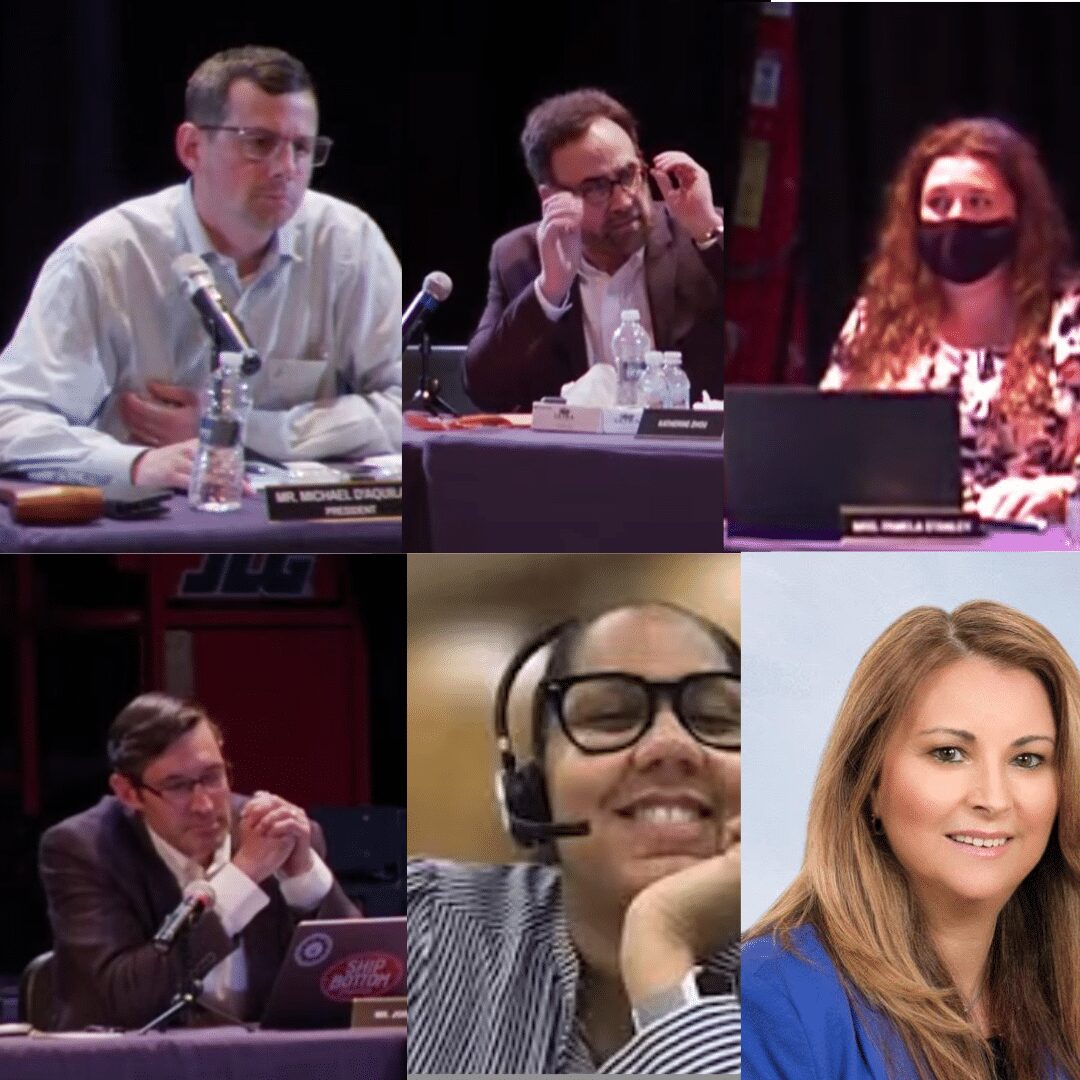
May 25th marked an anniversary for the Berkeley Heights School District, but not a happy one. This is the date when, in 2022, Robert Cianciulli brought forth a motion to have the board attorney draft ethics charges against another board member. The motion was approved, with ‘yes’ votes from Mike D’Aquila, Robert Cianciulli, Jordan Hyman, Angela Penna, Pamela Stanley, and Joy Young. This vote was the first in a series of poor decisions by various members of the board. These actions prompted three separate members of the public to file ethics complaints against these members of the Berkeley Heights Board of Education.
It has now been FOUR YEARS, and this case is still open, thanks to continued poor decision-making by some present and past members, the consolidation of the three cases, and the slow pace of over-burdened courts. Here is a recap of events, and an update on where the case stands presently.
After the initial vote that sparked all of this, the first ethics complaint was filed in early June. Two additional complaints would be filed over the next few months; one on the heels of the first, very similar as to which points of the school ethics code were violated, and one later which focused on Pamela Stanley’s September 2022 vote, which provided her legal representation via the taxpayer-funded board attorney.
Despite requests from the board attorney to have the complaints dismissed, the School Ethics Commission (SEC) found merit to all three. All three were forwarded to the Office of Administrative Law (OAL). At this point, the first two complaints, sharing substantial similarities, were combined in March of 2023 by an OAL judge.
The third complaint would eventually be combined with the first two, with legal representation for the complaint taken over by an attorney for the School Ethics Commission.
The combined cases were heard by the OAL judge, who issued a decision that the members of the board cited in the complaints were found to have violated the School Ethics Code. That decision, along with a recommendation for reprimand, was returned to the SEC. In turn, the SEC ruled, in its January and February 2025 meetings, that the body was in agreement with the decision on violations, but they recommended elevating the corrective measure from ‘reprimand’ – a formal, written rebuke – to ‘censure’, where the rebuke must be read in public.
That could have been the end of it. A statement read at a BOE meeting. However, at least two of the board members were in favor of challenging these findings and starting an appeal. The appeal was sent to the Commissioner of Education, and here is where we are stalled.
The appeal, as required, was filed within 30 days of the SEC ruling. Some agencies are constrained to 45 days to issue a decision on the appeal, but that doesn’t appear to apply to the Commissioner of Education. The matter has been with the Commissioner for OVER A YEAR, with no resolution.
One begins to wonder if there is political motivation at hand, and if so, what that motivation may be. Is it to send a message to those who would challenge board members whose actions may violate ethics, that there is really no ‘winning’, therefore discouraging the public from filings? Is it to teach a ‘lesson’ to residents in school districts who involve themselves in board meetings? It’s all open to the imagination. Meanwhile, AI has this to say:
- The SEC’s public decision archive (going back to 1997) does allow tracking of start and end dates when documented.
- The most extended recent case appears to be the Berkeley Heights consolidated cases (C64-22, C77-22, C92-22): nearly 2 years and 8 months from first complaint to final SEC adoption of the ruling. That seems unusually long compared to typical cases, which often resolve within ~1–1.5 years — depending on whether the matter goes to OAL.
- However: ”Duration” is imperfect as a metric. Some cases are dismissed early (after “no probable cause” findings) and don’t go to OAL — these may cycle faster but may not show up as “long” on paper. Many older cases (pre-2000s) may have incomplete online records. So what looks like “longest” may just reflect better public documentation.
- Because SEC meets monthly (except December) and because appeals, hearings, motions, and scheduling delays are common, even “normal” cases can stretch many months.
- At least in the publicly available record, the Berkeley Heights consolidated case (2022–2025) stands out as one of the longest well-documented school-ethics matters in recent years.
- Several other cases (especially from 2020 onward) took between ~1.5 to 2.5 years from complaint to resolution — which suggests that prolonged timelines are not exceptional, especially when OAL hearings are involved.
- Without a comprehensive “duration database,” it’s impossible to say definitively if any earlier case (e.g., 1990s or early 2000s) was longer — it may simply lack complete online documentation.
“Happy Anniversary!”
Editor’s Note: It should be noted that the Commissioner of Education is a politically appointed position. Despite multiple affirmations of ethics violations by an Office of Administrative Law (OAL) judge and the School Ethics Commission (SEC), the Commissioner’s office has still not acted to conclude this case. It should also be noted that Cleary, Giacobbe, Alfieri, Jacobs, LLC, the law firm representing the Board of Education members in this matter, boasts an immensely influential legislative footprint, with sitting State Senator Joseph Lagana (D) and sitting State Assemblyman Sean Kean (R) on staff as partners.
Disclosure: NJ21st co-founder Shauna Williams is one of the individual members of the public who filed an initial ethics complaint in this matter. Additionally, NJ21st submitted an amicus brief to the Commissioner of Education in support of the SEC and OAL findings against the cited members of the Berkeley Heights Board of Education.
Related Articles
From 2022 to Censure: The Full Breakdown of the Berkeley Heights BOE Ethics Case Final Administrative Ruling
The Rest of the 07/21 Berkeley Heights Agenda: $1.9M in Unitemized Bills, Unclear Contracts and More Words in the Air