Dr. Stacey Tavel is a resident of Millburn, NJ
Don’t Be Tricked Into Voting Yes
(Everything you need to know about the upcoming election in 9 minutes)
You’ve seen the lawn signs with the deceptively simple message: Vote YES or NO. And it’s probably hard to pull yourself away from end-of-year celebrations, packing for summer camp and graduations, but I want to ask for your attention because, through a process that’s been deceptive and misleading, we are about to consider reinventing the way our town has been governed for 169 years.
And make no mistake: I believe the Charter Commission chose the busiest week of the year to push through a long-standing plan. We are being asked to vote in one of the most consequential municipal elections our town has faced in a generation during the week when all focus should be on important milestones. But our vote will not be suppressed.
Before you head to the polls, let’s boil down what is actually on the ballot.
How Did We Get Here?
Last November, a small minority of Millburn’s 16,576 registered voters turned out for a ballot question. Only about 6,827 votes were cast, with 65.3% opting to form a Charter Commission to study our current form of government. While that sounds like a strong mandate, it represents just 26.9% of our total voting community.
(Consider that my not-so-subtle plug to vote on Tuesday!)

From that initiative, five commissioners were elected to study the town charter. They ran as an organized slate, funding their campaign through their own personal donations. (Note that these were the only five candidates out of a field of fourteen to run as a slate and raise money for their campaign). While they represent different political backgrounds, the fact that they ran as a unified block raises the question whether their recommendations truly reflect the diverse perspectives of our entire township.
Government-insider bias in evidence collection
In that spirit, their perspective was clearly driven by select government officials, past and present, to read like a list of officeholder frustrations: exhausting campaigns, steep learning curves, lame-duck stretches, mayoral-selection friction. The public was allowed to comment and ask questions at meetings, but we were never interviewed. No town-wide survey was conducted and although citizens could voice their concerns and questions on the commissioners’ findings, it’s unclear whether they considered our opinions at all. It is hardly surprising that the final recommendations echoed their initial view. This is what we call confirmation bias.
The Commission decided to abandon its Township Commission and replace it with a Council-Manager form of government more common in massive cities like Newark, Paterson, and Trenton. For all intents and purposes, this research felt like it was done in the opposite order of the scientific process. First the Commissioners made their decision, and then evidence was collected to support their conclusion.
The Faulkner Act: What Happens If We Vote “YES”?
If the majority votes “YES”, our local government will fundamentally change:
- Structure: We will shift to a Council-Manager form of government.
- Elections: Local elections will change from partisan to non-partisan.
- Council Size: The governing body will expand from five to seven members.
- Terms: Term lengths will increase from three to four years.
- Direct Legislation: Citizens will gain the power of Initiative (the ability to propose and pass ordinances directly via petition) and Referendum (the ability to petition to repeal ordinances passed by the Council).
I do not doubt that the Charter Commission invested extensive time and due diligence, conducting eighteen public meetings. They are dedicated members of our community for whom I have the utmost respect. When I first met with committee members, I thought that it would be an easy sell. In an era of intense political divisiveness, the idea of “non-partisan” local elections sounds incredibly appealing.
However, after digging deeper into the mechanics of the Faulkner Act, I found myself arriving at a difficult conclusion: I agree with the problems the Commission identified, but I strongly disagree with their solution.
The Illusion of “Non-Partisan” Politics
A major driving force behind this charter change appears to be dissatisfaction with how our current government has managed state-mandated affordable housing obligations. But let’s be honest: decades of avoiding master planning across multiple administrations have left us with a complex issue. If mistakes were made, there is plenty of blame to go around. When we are dissatisfied with our representatives, the solution is to hold them accountable at the ballot box — not to rewrite our entire constitutional structure to force a specific political outcome. Changing our form of government should not be a reactionary mechanism to tip the scales for or against one specific issue or party, yet my research picked up a distinct feeling of retaliation underlying this effort.
I initially voted for the creation of a Charter Commission because re-evaluating our local government seemed like a healthy, constructive exercise. However, almost immediately after the findings were released, our town was swept into a highly partisan political storm of lawn signs, billboards, social media arguments, and staged meetings. Instead of educating the community with the unbiased, objective facts we needed to make an informed decision, the presentation of the charter relied heavily on a small number of anecdotes aimed at criticizing one specific political party. Rather than educating our community on their findings, the process felt more like an attempt to politically sideline a group.
To see proof of how politically fragmented we are, look no further than our most recent local election numbers. The vote was split almost perfectly down the middle:
Jamie Serruto (R): 25.62%
Kris Heinrich (R): 24.75%
Annette Romano (D): 24.71%
Michael Cohen (D): 24.92%
Then go visit the new development at the site of the old Annie Sez building on Milburn Avenue. I’m not commenting on the aesthetics or traffic flow, so please keep an open mind.
A multifamily development featuring 150 residential units — including 30 designated for affordable housing — is currently underway. The “Vote YES” campaign has erected a billboard pointing directly at our future neighbors’ homes that reads: “If Millburn Had Been Non-Partisan, This Probably Wouldn’t Exist.”
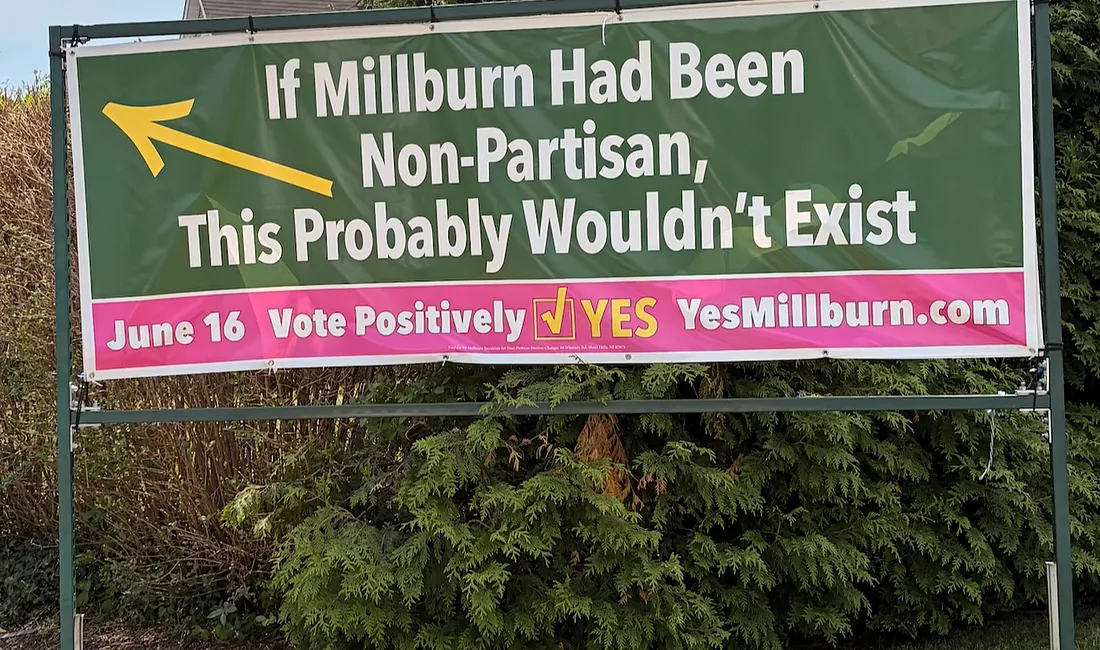
We watched one partisan group block our affordable housing obligation for decades, it is no surprise it is being held up as some sort of litmus test for this vote. But the reason the project is underway is because of Milburn’s low number of affordable housing units required by state mandate and failure to construct a sensible master plan (like our neighborhing towns of Summit and Chatham). So this sign should really read: “A “YES” vote will keep them out.”
When researching and presenting a new town charter, political agendas and beliefs should not be a part of this process. Our next municipal election is in November, and we will have plenty of time to debate issues before then. It is hard to ignore the fact that the spouse of one of our candidates in that upcoming November election served on this Charter Commission. Let that sit for a minute, and consider the implications.
Frankly, I find that sign on Millburn Avenue pointing to a new development unwelcoming. We should be preparing to invite our new neighbors to the community with grace, not using their future homes as political ammunition. We are starting to see this lack of decency and tension boil into the Millburn High School lunch room. Changing party labels will not erase party lines; it simply masks them from voters on election day, reducing transparency while keeping the underlying friction alive.
The Risk of Direct Democracy: hyper-local weaponization
The most concerning, yet least discussed, element of this proposal is the introduction of the Initiative and Referendum process. This is another issue that I fear too few of my fellow townspeople understand. In fact the Commission downplays this aspect, suggesting it is too difficult to execute in practice. If you haven’t done your research, you may not even know that this is on the ballot, which is direct democracy, a way to bypass the best judgement of our elected officials.
To force a town-wide vote on local legislation, a group needs to collect signatures equal to roughly 10% to 15% of the votes cast in the last regular assembly election — which amounts to only about 1,200 signatures in Millburn. In a community as passionate and politically active as ours, gathering 1,200 signatures is a plausible task. All four candidates hovered around 3,700 votes in our last election, proving the numbers are there. With the help of social media, catchy slogans, and scare tactics, reaching that threshold will not be difficult. In this system, Council members will have little incentive to work with their fellow council members, as they can turn to their supporters to help either get ordinances passed, or likewise block vetted ordinances of their adversaries.
Allowing private citizens — who lack legal counsel, municipal budget access, and a fiduciary duty — to draft binding laws or halt infrastructure projects invites chaos. A stalled budget process puts our coveted AAA credit rating at immediate risk — jeopardizing a rating we achieved precisely because our government currently functions so well, while simultaneously threatening our schools.
Under the Faulkner Act, this new avenue for grievances could easily paralyze Town Council operations. The consequence of losing a good rating would be that the interest (on the debt) the school pays increases, and that takes money from whatever little is discretionary spending (given that 80% goes to employees’ salaries and benefits) and could lead to sudden cuts to a lot of enrichment programs in the classrooms. Teachers could be laid off in the extreme cases. Is this likely? Hopefully not. Nonetheless, why would we risk the jewel of our township, the excellent public school system.
The Path Forward is Supposed to be Challenging
We do have a structural problem in Millburn: Independent candidates face a steep uphill battle to get elected. The Charter Commission successfully highlighted this issue, and we should all agree that opening the door for the most qualified candidates to serve is a worthy goal.
However, we can fix this without overturning our entire system of government. In fact, recent changes — some mandated by state courts — are already leveling the playing field naturally:
- The Demise of “The Line”: A recent landmark federal court ruling abolished the traditional “party line” ballot layout in New Jersey primaries. Candidates are now listed in random order, eliminating the unfair advantage previously held by party-backed candidates. We already saw this work in our last primary, where non-party backed candidates succeeded.
- Dynamic Parties, Not Monoliths: Local party committees in Millburn do not operate as rigid monoliths. Committee involvement largely ends after endorsements; they do not dictate policy to elected officials. Once in office, committee members regularly disagree and make independent decisions.
- Freedom of Slogans: During the general election, candidates — even those backed by a party — are free to choose any slogan they want. They are never locked into a partisan script.
The Charter Commission is relying on a few anecdotal stories to draw sweeping conclusions, suggesting their minds were made up long before this “unbiased research” began. If we vote NO, the message to our local party committees is still loud and clear: Millburn expects them to operate with open minds and make room for new voices. With 43% of our town registered as unaffiliated, our community is clearly hungry for moderate, pragmatic candidates.
We don’t need a new charter to get them. Unaffiliated voters can easily vote in primaries by declaring a party and switching back immediately afterward. Independent candidates can enter the general election directly — and in a town like ours, where voters are struggling to feel comfortable in any single political party, voters are more than ready to give independent voices a serious look. Let’s reform our political culture, not rewrite our constitution.
Millburn is a high-functioning, exceptional community filled with passionate, intelligent people. It’s insulting how we are being promised a process that’s fairer but actually masks who makes decisions and removes important guard rails driven by short-term reactionary personal gain.
We agree on the problem, but not on the solution. VOTE NO.
So don’t let our elected officials take the easy way out — the one where a tidy label substitutes for actually doing the hard work. The real test isn’t whether they share a political party, a party with an ambiguous title (“Vote for Millburn”- aren’t all candidates who are volunteering their personal time doing it “for Millburn”), or a slate (funded by deep pockets). It’s whether they can sit across from someone they disagree with, listen, and still get something done. That’s what earns our trust. Not a “non-partisan” rebrand.
As the saying goes, if we all could “act like our kindergarten teacher was watching us,” I believe 99% of our problems would be solved.
Please take a moment amidst the graduations, the packing, and the celebrations this week to make your voice heard on Tuesday, June 16th.
Sometimes the best solution is no change at all.
A bandaid, like “non-partisan” elections won’t stop a hemorrhage caused by how we treat each other.
I will be voting NO on Tuesday, June 16th, and I encourage you to do the same.
If you would like to share this perspective with others, please forward it along. But quickly…we are just a few days away from changing our government and creating a a 24/7, 365 day political cycle in our town. I don’t know about you, but when elections are over, regardless of the result, I am happy to return to my regular life. After all, we all moved here to enjoy our families.
Happy Milestone week!
Submitted directly by the author; content reflects their own views

Related Articles

Property TaxesPart 4 – Revaluation
SAT Score Showdown: How Our 7 Districts Ranked Statewide